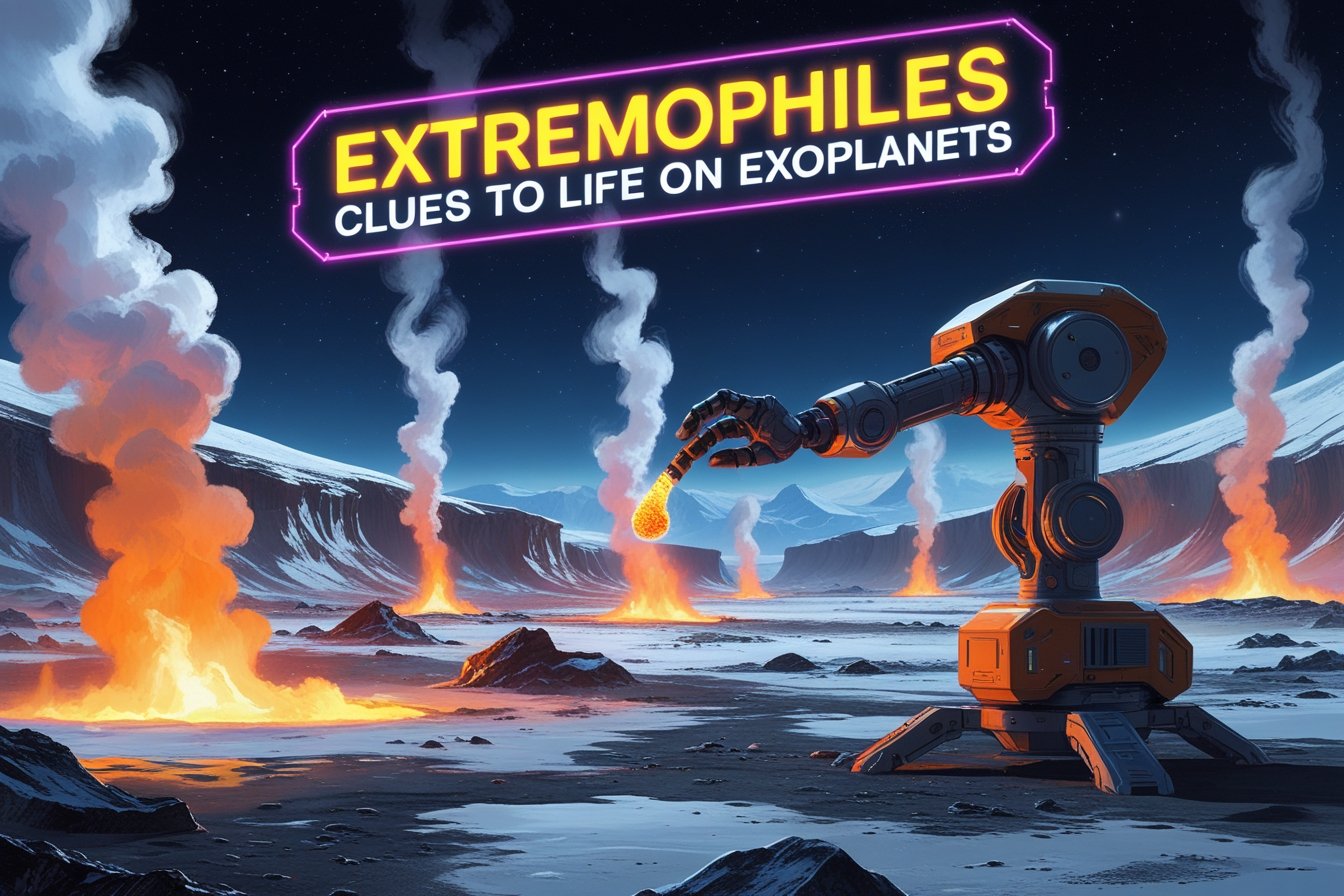
Deep beneath Earth’s most inhospitable environments, life has evolved in remarkable ways, defying our conventional limits and rewriting the rules of survival. Extremophiles are not just biological curiosities; they are windows into how life might exist on distant worlds. Their uncanny ability to thrive under conditions lethal to most organisms offers vital clues to life on exoplanets. As we expand our search for habitable worlds, the resilient tactics of these organisms fuel our hope and inform our exploration. Let us journey beyond the ordinary, where life endures in extremes, and these cosmic survivors guide our quest for extraterrestrial life.
Cosmic Pioneers: Life at the Limits:
On Earth, extremophiles inhabit environments that span scalding hydrothermal vents, acidic hot springs, frigid polar deserts, and places with crushing pressures. These resilient organisms morph their biochemistry to flourish under stress, whether by utilizing underground energy sources or safeguarding their genetic material against high radiation. In doing so, extremophiles push the boundaries of what we understand as habitable. Their adaptability is a testament to nature’s ingenuity, and it challenges us to think beyond the narrow confines of Earth’s traditional life zones. The new frontier of astrobiology draws inspiration from these pioneers, suggesting that what seems uninhabitable to us might just be perfect for other forms of life 2.
Molecular Legends: The Chemistry of Survival:
At the microscopic level, the secret of extremophilic success lies in their molecular machinery. These organisms produce specialized proteins and enzymes that resist denaturation at high temperatures, maintain stability in acidic or alkaline settings, and repair DNA damaged by ultraviolet or ionizing radiation. This molecular ingenuity is pivotal as it shapes the biochemical blueprint of survival.
For instance, some thermophiles generate heat-stable enzymes that have revolutionized industrial processes, while psychrophiles produce antifreeze proteins that prevent the formation of ice crystals at subzero temperatures. By studying these adaptations, scientists glean insights into biochemical pathways that might operate on planets with vastly different climates or geochemical conditions. Extremophiles, therefore, not only thrive in Earth’s extremes but also act as living laboratories, unraveling the chemistry that could sustain life in distant solar systems.
Earth’s Hidden Extremes: Nature’s Exoplanet Analogues:
When researchers explore extreme terrestrial environments, they are, in effect, peering into conditions that may mimic those on far-off exoplanets. Deserts with scorching temperatures, deep-sea vents emitting superheated, mineral-rich fluids, and the vast, frozen landscapes of polar regions all serve as analogues to environments found or hypothesized on other worlds.
Take, for example, the frigid deserts of Antarctica’s Dry Valleys, a terrestrial setting where liquid water is scarce, yet microbial life persists. This landscape offers clues to potential life on Mars or icy moons like Europa, where surface conditions are harsh and water is locked in ice. Similarly, acid mine drainage sites on Earth simulate the low pH and mineral-rich conditions that might exist on volcanic exoplanets. By understanding how extremophiles navigate these challenges, astrobiologists can refine their models of habitability and tailor life-detection missions to environments that were once thought too extreme to host life.
Celestial Blueprints: Guiding the Search for Life on Exoplanets:
The existence of extremophiles is a cornerstone in justifying the search for life beyond our planet. Their presence on Earth suggests that the parameters of habitability are much broader than once presumed. This paradigm shift is crucial as it extends the scope of target exoplanets and moons, guiding where and how we look for life.
Scientists now focus on worlds that might seem hostile at first glance—planets orbiting red dwarf stars with extreme variability, super-Earths encased in thick, scorching atmospheres, or icy bodies in the outer reaches of a solar system. The resilience of extremophiles implies that life could, in theory, take root on exoplanets with environments previously written off as barren. Their stories inform telescope observations, spectral analysis, and even the engineering of landers designed to detect life forms that have evolved under extreme conditions. It is a cosmic promise that if life can adapt to Earth’s most forbidding habitats, then life might well be waiting for us on another star.
Laboratory Frontiers: Simulating Alien Worlds on Earth:
Groundbreaking research continues as scientists replicate the harsh conditions of space in laboratory settings. Environmental simulation chambers recreate the low pressures, high radiation, and extreme temperatures that extremophiles might encounter on an alien world. These experiments allow researchers to observe, in real time, how microbial life responds, adapts, or even thrives under simulated Martian, Europan, or Titan-like conditions.
Such studies are essential for validating our hypotheses about alien life. By placing Earth’s most tenacious organisms into these chambers, researchers can test survival thresholds, metabolic changes, and genetic adaptations under controlled conditions. This convergence of biology and technology not only hones our understanding of extremophiles but also refines the instruments and methodologies used in space exploration. It bridges the gap between observable Earth-life and the anticipated biology on exoplanets, offering a tangible foundation upon which missions can be planned and executed.
Beyond Horizons: Implications for Astrobiology and Future Discovery:
The exploration of extremophiles extends far beyond academic curiosity—it carries deep implications for our pursuit of life beyond Earth. By studying these resilient organisms, astrobiologists are unlocking a new framework for understanding what it means to be “alive.” With each discovery, researchers edge closer to defining biological boundaries that can be applied to exoplanetary environments.
This research influences the design of future space missions and informs the development of instruments capable of detecting subtle biosignatures. Whether through direct imaging, spectral fingerprinting, or in situ analysis on the surface of a distant planet, every technique is refined by lessons learned from terrestrial extremophiles. Their very existence amplifies the hope that life, in some form, might adorn the universe, challenging human assumptions about the fragility and rarity of biological existence.
Furthermore, the study of extremophiles inspires a multidisciplinary dialogue that spans biology, chemistry, geology, and astronomy. In an age where our understanding of life is continually evolving, these organisms serve as both a humbling reminder of nature’s adaptive capacity and a beacon guiding our celestial explorations. They compel us to look at the universe not as a collection of isolated worlds, but as a dynamic continuum where the possibilities of life are as vast as space itself.
Digital Diviners: How Data Science Merges with Biology:
In the modern era of high-throughput data analysis and machine learning, the study of extremophiles has taken on a digital dimension. Researchers are now harnessing powerful computational tools to decipher the vast genomic datasets generated from these resilient organisms. Algorithms help identify genetic markers that signify heightened resistance to environmental extremes and predict how these markers might operate in alien environments.
By integrating genomics with sophisticated bioinformatics, scientists can simulate potential evolutionary pathways under exoplanetary conditions. This digital approach not only accelerates discoveries but also builds predictive models that may one day aid in the direct detection of life on exoplanets. The convergence of data science and astrobiology heralds a new phase of research where every byte of information brings us closer to answering the age-old question: Are we alone?
Conclusion:
The journey from Earth’s most forbidding environments to the enigmatic landscapes of distant exoplanets is a tale of resilience, innovation, and boundless curiosity. Extremophiles, nature’s intrepid survivors, offer us profound clues about the possible existence of life beyond our home planet. They illustrate that life can flourish under conditions that, at first glance, seem utterly inhospitable, thereby expanding the parameters of habitability in the universe.
As we continue to refine our techniques, both in the laboratory and with spaceborne instruments, the legacy of these remarkable organisms will guide our steps on unexplored cosmic terrain. The fusion of cutting-edge technology with the timeless ingenuity of life serves as a reminder that the search for extraterrestrial life is not just a scientific endeavor, it is an exploration of our deepest potential as explorers of the cosmos. The clues left by extremophiles are our cosmic signposts, leading us toward an exciting future filled with discovery and wonder.
FAQs:
Q1: What are extremophiles?
Microorganisms that thrive in extreme environments.
Q2: How do extremophiles help our search for life on exoplanets?
They reveal survival strategies for harsh conditions.
Q3: Where can extremophiles be found on Earth?
In extreme habitats like hot springs, deserts, and hydrothermal vents.
Q4: Why are extremophiles important for astrobiology?
They expand our view of possible habitable conditions.
Q5: How do researchers study extremophiles in labs?
By simulating extraterrestrial conditions.
Q6: What is the ultimate goal of studying extremophiles?
To guide the search for life beyond Earth.