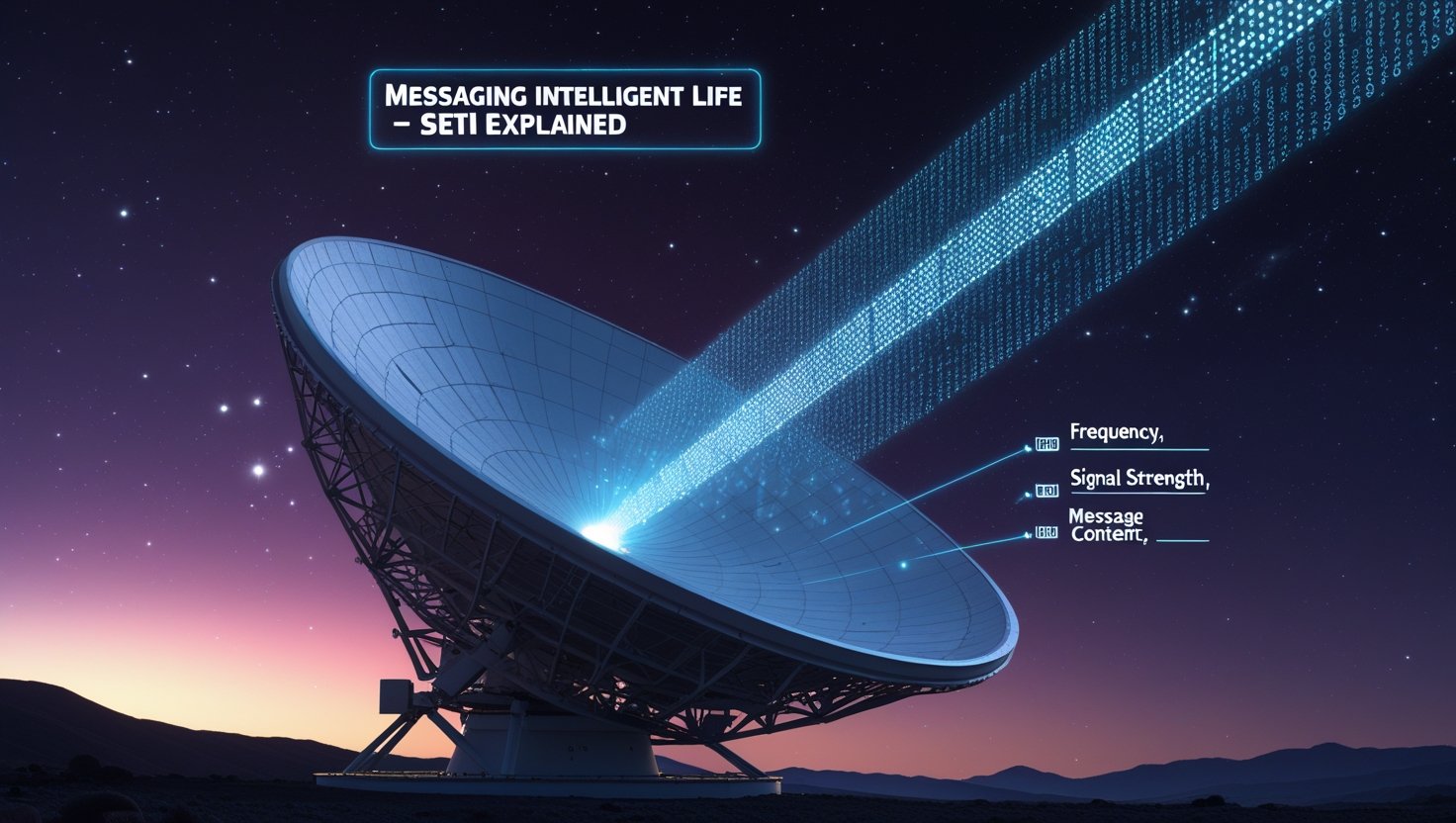
Imagine transmitting a hello from Earth that echoes through the cosmos. Messaging Intelligent Life isn’t just science fiction, it’s a bold, scientific endeavor that seeks to break the cosmic silence. In this article, we dive into what SETI (Search for Extraterrestrial Intelligence) is all about, how we’ve evolved from merely listening to actively sending messages, and what these efforts mean for humanity. Let’s explore this fascinating frontier where technology, philosophy, and hope converge.
The Cosmic Quest:
At its core, SETI is the scientific search for extraterrestrial intelligence by monitoring signals from space. Over the decades, SETI has evolved from passive listening missions to active strategies. The traditional approach listens for any signs of alien communication, using immense radio telescopes to scan the sky for nonrandom signals. More recent initiatives, often referred to as METI, Messaging to Extraterrestrial Intelligence, actively send deliberate messages from Earth into the void.
This dual approach invites us to both hear and speak to potential cosmic neighbors, highlighting our desire to connect with unknown intelligences beyond our planet. By bridging these strategies, scientists hope to answer one of humanity’s most enduring questions: Are we alone in the universe?
From Passive Reception to Active Outreach:
The history of SETI is marked by a fascinating transition. Early efforts, such as Project Ozma in the 1960s, relied solely on passive detection methods, just listening to the vast radio spectrum for hints of an intelligent signal. However, as technology advanced, the concept of Messaging Intelligent Life emerged. Active SETI, or METI, involves crafting signals, modulating frequencies, and then transmitting them into space with the intention of being detected by other technological civilizations.
Iconic messages like the Arecibo Message or the plaques attached to spacecraft such as Pioneer represent humanity’s first deliberate attempts to speak to the cosmos. This proactive approach is not without controversy, as researchers continue to debate whether announcing our presence might invite unforeseen consequences. Yet, this evolution from passive to active strategies showcases our relentless curiosity and desire to communicate on a universal scale.
The Tools of Cosmic Communication:
Behind every message sent into the void lies a marvel of modern engineering. SETI Explained wouldn’t be complete without an appreciation of the technology that makes these endeavors possible. Radio telescopes such as those at Arecibo Observatory, as well as cutting-edge satellite dishes around the globe, are our eyes and ears in the night sky. These instruments are designed to pick up faint, distant signals while simultaneously sending deliberate pulses back into space. Transmitters used in active SETI projects harness powerful radio frequencies adjusted to mimic the patterns of natural phenomena but constructed in clearly identifiable ways.
Engineers and scientists continually refine these devices to boost their range and sensitivity, ensuring that our messages aren’t just whispers but bold declarations aimed at awakening curious minds light-years away. The integration of high-precision hardware with sophisticated software makes it possible to encode a vast amount of information into every symbol, paving the way for meaningful interstellar conversation.
Crafting the Cosmic Message:
Every message intended for extraterrestrial recipients is more than just a series of signals, it’s a carefully constructed representation of Earth and humanity. Scientists grapple with the challenge of conveying information in a universally understandable format. The Arecibo Message, one of the most famous transmissions, utilized a series of binary codes to describe basic numbers, chemical structures, and even a representation of our solar system. Such communications aim to transcend language barriers by relying on the language of mathematics and science, a language that, theoretically, could be understood by any advanced civilization.
Modern METI initiatives continue this legacy, incorporating artistic elements, pictorial representations, and even music frequencies that reflect human culture and diversity. The goal is not only to announce our existence but also to offer a glimpse into the collective identity of our species, our scientific achievements, and our place within the cosmic tapestry.
Risks, Rewards, and the Great Debate of Messaging Intelligent Life:
The venture of sending a message to potential extraterrestrial civilizations is as controversial as it is inspiring. Critics argue that revealing our location and technological capabilities could invite unwanted attention from a potentially advanced or hostile civilization. Renowned figures such as Stephen Hawking have cautioned against alerting unknown entities to Earth’s presence, comparing the act to disturbing a dormant predator. On the other side of the debate, proponents of active SETI contend that the universe is so vast, and the odds of contact so remote, that the benefits outweigh the risks.
They emphasize that any advanced civilization capable of interstellar travel would likely have detected Earth through our unintentional emissions, like television and radio broadcasts, long before we ever sent a dedicated message. This debate encapsulates the tension between caution and curiosity, driving ongoing discussions in scientific, political, and public spheres. Ultimately, the risk-versus-reward calculus remains one of the most complex questions in our quest for cosmic communication.
Global Collaboration and Policy:
In the realm of Messaging Intelligent Life, international cooperation and policy-making play pivotal roles. Since any message broadcast into space has implications for all of humanity, the decision to send one should ideally involve a global consensus. Various scientific organizations, such as the SETI Institute and METI International, actively engage in discussions to determine the ethical and practical boundaries for such initiatives. Conferences, policy debates, and public consultations contribute to a broader understanding of the potential consequences of active messaging.
Some researchers advocate for a formalized global regulatory framework before any further transmissions occur, while others believe that the current decentralized approach reflects the cooperative spirit of our times. The debate over who holds the authority to speak for Earth underscores the fact that Messaging Intelligent Life is not just a scientific endeavor, it is a global project that touches on culture, security, and our shared destiny in the universe.
How SETI and METI Shape Humanity’s Outlook:
Beyond the technological and scientific challenges, SETI and active messaging efforts have profound philosophical and cultural implications. The idea of reaching out to the cosmos stirs the imagination and unifies people around a common quest for knowledge. For many, the possibility of making contact with another intelligent species is a source of hope, a signal that life, in all its manifold forms, might be more widespread than we ever imagined. This quest has spurred artistic expressions, inspired films and literature, and even influenced educational curricula worldwide.
The pursuit of extraterrestrial communication also impacts scientific research on Earth, driving advancements in robotics, signal processing, and even artificial intelligence. In this way, Messaging Intelligent Life becomes a mirror that reflects our aspirations, fears, and the timeless human urge to explore the unknown. It nudges us to appreciate our place on a pale blue dot, reminding us of both our fragility and our remarkable capacity for innovation.
The Next Steps in Cosmic Communication:
As we look to the future, the field of SETI is continually adapting and expanding. Emerging technologies such as artificial intelligence, quantum computing, and enhanced space telescopes are set to revolutionize how we both listen for and send messages into space. Researchers are exploring new methods of encoding information that could be more efficiently decoded by alien intelligences and developing adaptive algorithms that can detect faint signals buried within cosmic noise.
There is also growing interest in interdisciplinary approaches that combine astronomy, linguistics, mathematics, and even the arts to craft messages that are as accessible as they are profound. The future of Messaging Intelligent Life will likely be characterized by a blend of scientific rigor, international collaboration, and visionary creativity. With each broadcast, we inch closer to the possibility of a reciprocal dialogue, one that could forever change our understanding of life, culture, and the cosmos.
Conclusion:
Messaging Intelligent Life and SETI Explained captures the essence of humanity’s quest to connect with the unknown. From the foundational work of listening with giant radio telescopes to the daring step of sending our own signals into the void, this pursuit embodies both the hope and the challenge of interstellar communication. As technology advances and the debate deepens, our message remains clear: we are here, we are curious, and we are ready to listen and speak to the stars.
FAQs:
1. What is SETI?
SETI (Search for Extraterrestrial Intelligence) is the scientific effort to detect signals from alien civilizations.
2. What is METI?
METI (Messaging to Extraterrestrial Intelligence) involves actively sending messages from Earth to seek potential extraterrestrial contact.
3. How do scientists send messages to space?
Scientists use radio transmitters and specialized antennas to send encoded messages that convey information about Earth and humanity.
4. What are some examples of cosmic messages?
Notable messages include the Arecibo Message and the Pioneer plaques, which have been sent to represent Earth’s scientific and cultural heritage.
5. Are there risks in sending messages to aliens?
Yes, some experts worry that broadcasting our presence could invite unwanted attention, while others believe the benefits of potential contact outweigh the risks.
6. What does the future hold for SETI and METI?
Future advancements in technology and global collaboration will likely lead to more refined methods of detecting and transmitting signals, deepening our understanding of the cosmos.